
Last updated October 31, 2026
 Home additions & ADU
 Kitchen remodeling
 Bathroom remodeling
 Roofing
 Windows & doors
 Driveway & pavers
 Fence
Free written scope consultation - allowances, timeline, and change-order rules on paper before a single trade is scheduled
General Contractor Maintenance Checklist for Rialto Homeowners
The single most expensive repair call Rialto contractors get every November is caulking failure around windows and doors. Not roof leaks. Not slab cracks. Caulking. It’s the kind of damage a $12 tube of sealant and twenty minutes on a September Saturday would have prevented, but it never makes the checklist because most maintenance guides are written for Seattle or Chicago, not the Inland Empire. A home in Rialto wages a different battle than a home in the Pacific Northwest. Our sun cooks exterior materials at 3,000-plus hours of direct exposure per year. Our Santa Ana winds sandblast fascia and loosen fasteners. Our municipal water leaves mineral deposits that shorten the life of every valve and fixture it touches. This guide is calibrated to what our General Contractor services actually see when walking Rialto homes year after year. If you own property here, this is the checklist that keeps a five-figure repair from becoming your November surprise.
Styles & brands we work with
Quick Answer
A Rialto home maintenance checklist should prioritize five local wear patterns: window and door caulking inspected every September before Santa Ana season, HVAC filters replaced every 30 to 45 days during dust-heavy months, water heater and hose bib descaling every 12 months due to Rialto’s hard municipal water, roof and vent fastener checks each October, and concrete flatwork and mortar joint inspection every spring when thermal cycling has done its worst. Most of this costs under $200 per year in materials if caught early. Ignoring it is how $12 caulking jobs become $4,000 water intrusion repairs.
Table of Contents
- Caulking and Sealants: The September Ritual
- Roofing and UV Degradation: What Rialto’s Sun Actually Does
- HVAC Filters and Coils: Rialto’s Dust Load Problem
- Hard Water: Water Heaters, PRVs, and Hose Bibs
- Santa Ana Wind Prep: Exterior Fasteners and Flashing
- Concrete and Mortar: Thermal Cycling Without the Freeze
- Exterior Paint and Siding: The UV Math
- A Seasonal Maintenance Schedule for Rialto
- Common Mistakes to Avoid
- When to Call a Professional
- Frequently Asked Questions
- The Bottom Line
Caulking and Sealants: The September Ritual
Rialto’s climate punishes caulking faster than almost any other exterior material. The combination of intense UV exposure, low humidity, and the thermal swing between 100-degree August afternoons and 45-degree December nights causes sealant to dry, shrink, and crack within two to three years. Not the five to seven years caulking manufacturers quote for coastal climates. Our experience walking Rialto homes in October and November confirms it: the most common point of water intrusion is the joint where window trim meets stucco, followed closely by door thresholds and exterior electrical penetrations.
Here’s the schedule that works here:
- Every September: Walk the perimeter of your home and inspect every window and door joint. Look for hairline cracks, pulling away from the substrate, or sealant that feels hard and brittle when pressed with a fingernail.
- Check the backside too: North-facing walls in Rialto still get ambient UV reflection from hardscape and neighboring structures. Do not skip them.
- Inspect utility penetrations: Where cable lines, electrical conduit, and hose bibs enter the wall, the original caulking is often builder-grade and long past its service life by year five.
- Replace with a high-quality sealant: A polyurethane or hybrid sealant rated for 50% joint movement handles Rialto’s thermal range better than basic acrylic latex caulk.
- Recaulk before October: Santa Ana season starts in earnest in October. Wet caulking applied in September cures before the winds arrive.
The cost difference is stark. A tube of quality sealant runs $10 to $15. The water damage from a failed joint that goes unnoticed through one rainy season typically runs $1,800 to $4,500 in stucco repair, drywall replacement, and mold remediation. In Rialto, where rain comes in short intense bursts rather than long soaking drizzles, failed caulking channels water directly into wall cavities. It does not bead up and evaporate the way it might in a humid climate.
One thing we see repeatedly is homeowners caulking over old, failed sealant. That traps moisture underneath and accelerates rot. The old stuff has to come out first. A $6 removal tool and twenty minutes of scraping beats a second repair six months later.
Roofing and UV Degradation: What Rialto’s Sun Actually Does
Rialto sits at roughly 1,200 feet of elevation in the Inland Empire, which means the UV index runs high from April through October. That changes the math on roofing materials. A concrete tile roof in Rialto does not fail the way an asphalt roof fails. The tile itself may last forty or fifty years. What fails is the underlayment beneath it, which bakes and becomes brittle decades before the tile shows visible wear. An asphalt shingle roof here loses granules faster than the same roof in Riverside or Ontario because Rialto’s specific microclimate, with its combination of high heat and periodic dry winds, accelerates the oxidation of the asphalt binder.
For Rialto homeowners, the inspection schedule looks like this:
Concrete tile roofs: Inspect the underlayment condition every five years starting at year fifteen. Look at the eaves and valleys where heat concentrates. If the underlayment is cracked or powdery, that’s a replace-before-it-leaks situation, not a wait-and-see. Tile roofs are not immune to water intrusion. They shed water to the underlayment, and when that layer fails, the leak is slow and insidious. By the time you see a ceiling stain, the decking underneath may already be compromised.
Asphalt shingle roofs: Expect 18 to 25 years of service in Rialto, not the 25 to 30 years quoted by manufacturers for milder climates. Check for granule loss in gutters and downspouts every spring. If you see bare spots or curling at the edges, budget for replacement within 12 to 18 months, not five years.
TPO flat sections: Many Rialto homes, especially those built in the 1980s and 1990s, have flat roof sections over additions or patio covers. TPO membrane here shows UV-related surface cracking and seam failure starting around year ten to twelve. An annual October inspection of seams and flashing is cheap insurance. A $400 seam repair beats a $6,000 membrane replacement.
When we work on roofing projects in Rialto, we source materials from GAF and CertainTeed for asphalt systems. For flat sections, we prefer a reinforced TPO with heat-welded seams. The brand matters less than the installation quality, but starting with a membrane rated for high-UV exposure gives you a head start. For full exterior transformations that include roofing, siding, and windows, check out our General Contractor in Bloomington page to see how we manage multi-trade projects under one contract.
HVAC Filters and Coils: Rialto’s Dust Load Problem
Rialto’s air quality is a different beast than coastal Los Angeles or Orange County. The city sits downwind of the Cajon Pass, which channels dust, construction particulates, and agricultural debris from the High Desert directly into the western Inland Empire. Add in local traffic from the 210 and I-10 corridors and the result is a particulate load that clogs HVAC filters faster than the standard 90-day replacement schedule assumes.
Here’s what we recommend for Rialto homeowners:
- Replace 1-inch filters every 30 to 45 days during peak dust season (April through October). A 1-inch MERV 8 filter in an average Rialto home is visibly dirty at the 30-day mark. Waiting 90 days means your system is working against restricted airflow, which raises energy costs and shortens blower motor life.
- Upgrade to 4- or 5-inch media filters if your system supports them. They last 6 to 12 months and do a better job capturing the fine particulates that blow through the Cajon Pass during Santa Ana events.
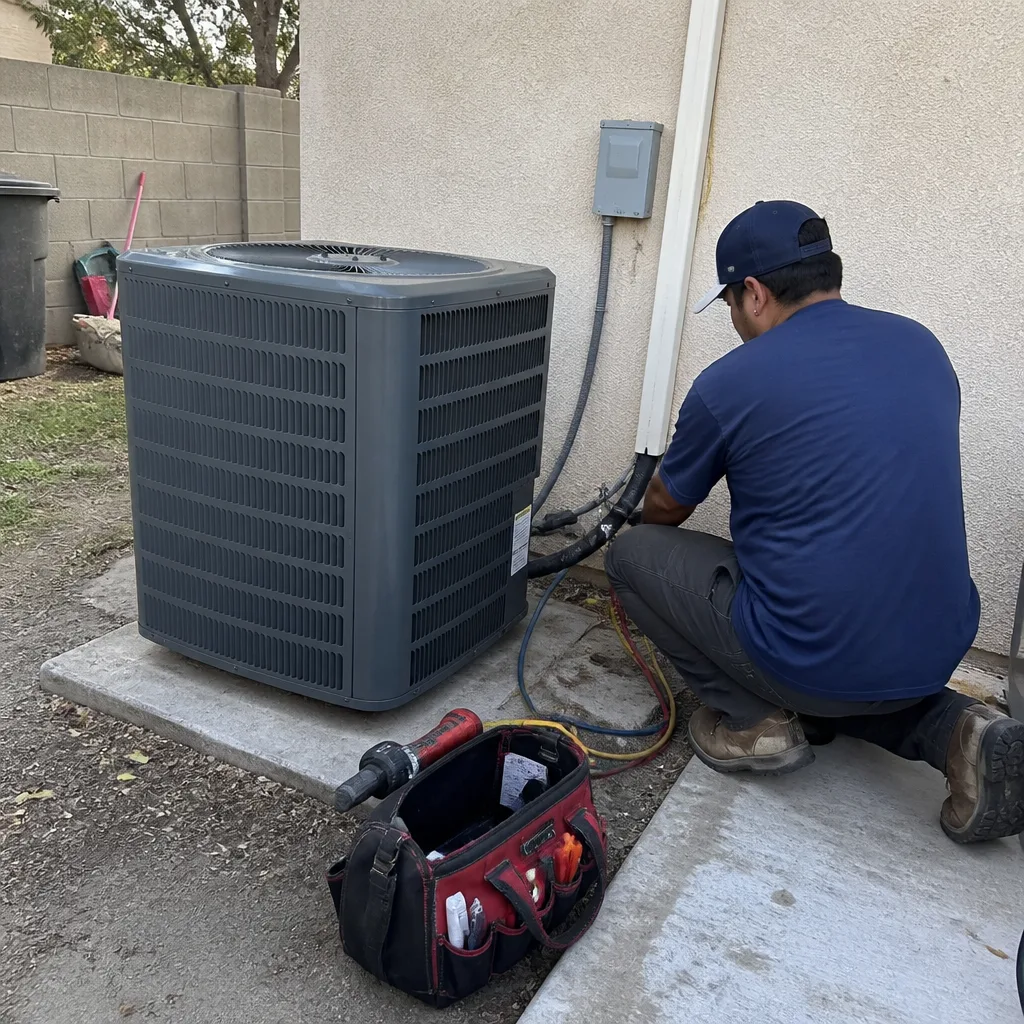
- Check your evaporator coil every two years. Rialto’s dust sticks to coil surfaces and combines with condensation to form a paste that insulates the coil and reduces cooling capacity. A $250 professional coil cleaning restores efficiency and prevents the $1,200 compressor failure that follows.
- Inspect the condenser unit monthly during summer. Cottonwood and eucalyptus debris, both common in Rialto neighborhoods, get sucked into the coil fins. A gentle rinse with a garden hose once a month during peak season keeps the system breathing.
The dust problem is not cosmetic. A system running with a clogged filter uses 10 to 15 percent more electricity and runs longer cycles to hit the same setpoint. At Rialto’s summer electricity rates, that’s a measurable hit on every SCE bill. And the strain on the blower motor compounds over time. Most blower motors in Inland Empire homes fail not from age but from working against restricted airflow for years.
This is not a replacement issue in most cases. It’s a discipline issue. Set a recurring phone reminder on the first of the month during summer. Your HVAC system will outlast the average Rialto system by several years.
Hard Water: Water Heaters, PRVs, and Hose Bibs
Rialto’s municipal water supply comes from a mix of local groundwater wells and imported surface water. The groundwater component carries significant mineral content, primarily calcium and magnesium carbonates. The result is water hardness that runs consistently in the hard to very hard range, depending on which wells are active in a given month. What that means for your home is scale buildup everywhere water sits, flows, or changes temperature.
The checkpoints that matter:
Water heaters: In Rialto, a tank water heater accumulates roughly a quarter-inch of scale on the tank bottom within three years. That scale layer acts as insulation between the burner and the water, reducing efficiency and causing the tank to overheat locally, which leads to premature tank failure. Flush the tank once a year. If you hear popping or rumbling when the heater fires, that’s scale, and it’s already thick enough to matter. Expect a tank water heater in Rialto to last 8 to 10 years without maintenance. With annual flushing, 12 to 15 years is realistic.
Pressure reducing valves (PRVs): Rialto’s supply pressure runs on the high side in many neighborhoods, and PRVs are the unsung workhorses that protect your fixtures. Scale builds up on the PRV’s internal components and causes two failure modes: pressure creep (where the valve stops regulating and lets full street pressure through) or pressure drop (where the valve sticks and your showers go weak). Check the pressure at a hose bib once a year with a $12 gauge. If you see pressure above 80 psi or below 40 psi, the PRV needs service or replacement. A $150 valve replacement protects your entire plumbing system from leaks, which is a better investment than any insurance policy.
Hose bibs and shutoff valves: Rialto’s hard water causes mineral buildup inside hose bibs and angle stops. You notice it when you turn the handle and feel grinding, or when the bib drips even when fully closed. Exercise every shutoff valve in your home twice a year. Turn them fully off and back on. This breaks up early scale formation and prevents the stuck-valve emergency where you cannot shut off water to a leaking fixture. A stuck angle stop under a sink during a fixture replacement means a whole-house water shutoff and a $300 plumber call instead of a $15 DIY job.
The good news is that the fix is mechanical, not chemical. You do not need a water softener to protect your home, though it helps with fixtures and appliances. The maintenance items above are sufficient for most Rialto homeowners. What matters is doing them on schedule, because hard water damage is cumulative and silent. You notice it when a pipe bursts or a water heater leaks, not before.
Santa Ana Wind Prep: Exterior Fasteners and Flashing
Santa Ana winds in Rialto are not the same as the gusts that scream through the Cajon Pass and hit Fontana or Rancho Cucamonga head-on. Rialto sits slightly south and west of the main wind corridor, but the city still sees sustained winds of 25 to 40 mph with gusts to 60 during strong events. That is enough to peel flashing, lift ridge caps, and rattle loose any fastener that has been working its way out for years.
The components that take the most damage:
Ridge caps and hip caps on tile roofs: The wind gets under the leading edge and lifts. Once one cap goes, the underlayment is exposed, and the next wind event works on the neighbors. Check ridge caps every October. Look for caps that have shifted or are missing mortar. A $25 bag of mortar and a re-bedding job prevents the $800 repair that follows a cap flying off in a December wind event.
Patio covers and shade structures: Aluminum patio covers in Rialto are notorious for losing fasteners at the beam-to-post connections. The wind works the lag screws loose over years, and one strong Santa Ana turns a loose connection into a structural failure. Inspect all fasteners annually. Tighten anything that moves. If you see rust staining at a connection, replace the fastener, not just tighten it.
Vents and exhaust terminations: Roof vents, dryer vents, and bathroom fan terminations are held in place by small screws that wind loosens over time. A missing vent cover lets rain directly into the attic or wall cavity. The $8 replacement vent is cheap. The water damage it prevents is not. Check every roof and wall penetration each October while you’re doing the caulking walk.
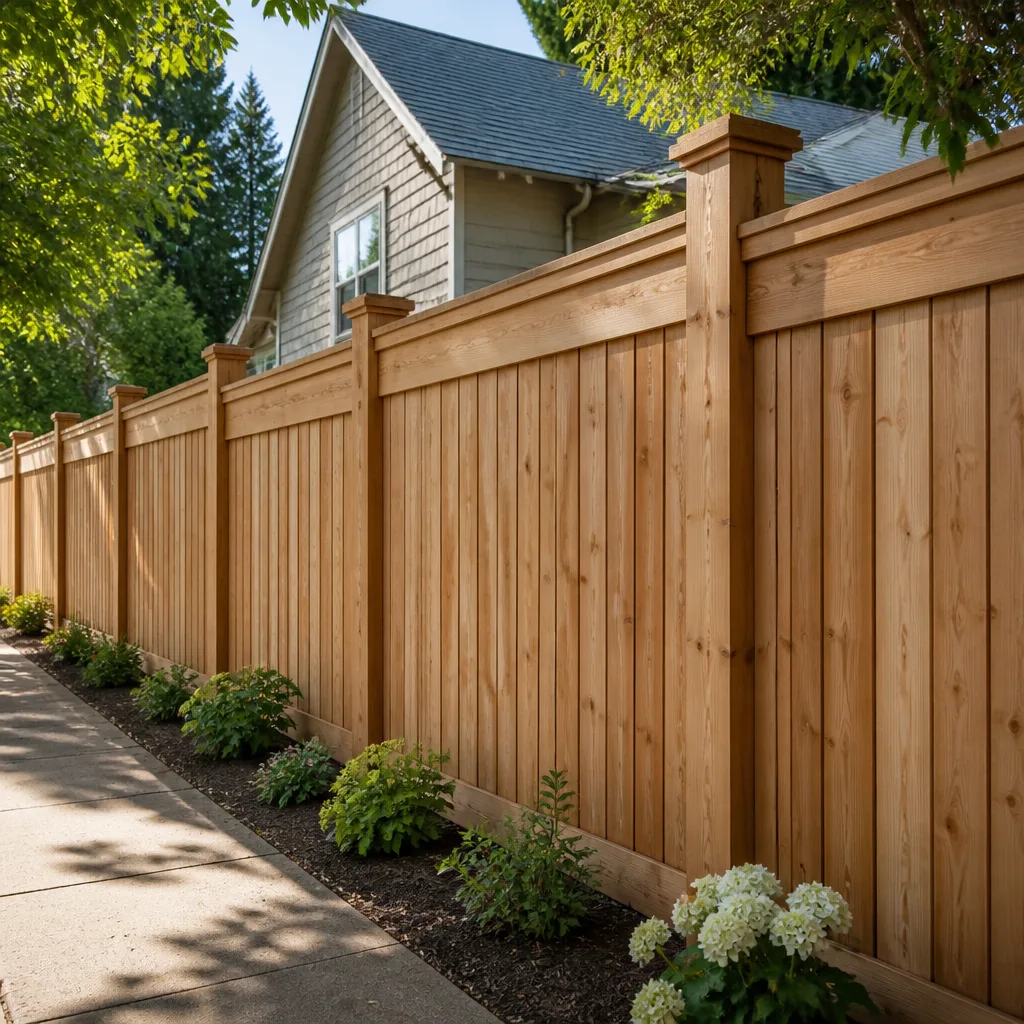
Fencing: Rialto’s fencing stock is a mix of wood, vinyl, and masonry block. Wood fences take the worst of it. Posts rot at ground level and the first big wind pushes the whole panel over. If you can wiggle a fence post by hand, it’s already due for replacement. Vinyl fencing from manufacturers like Barrette, which we source and install, holds up better in wind because the panels flex rather than fail, but only if the posts are set in concrete at the correct depth. A wind-rated vinyl fence in Rialto should have posts set 30 to 36 inches deep. Shallow-set posts fail regardless of brand.
Concrete and Mortar: Thermal Cycling Without the Freeze
Rialto does not get the freeze-thaw cycling that destroys concrete in the Midwest or Northeast. What we get instead is a slow, relentless thermal expansion and contraction cycle driven by summer heat and winter cool. The temperature swing between a 105-degree summer afternoon and a 40-degree winter night is not dramatic by national standards, but it happens thousands of times over the life of a home. The result is concrete that cracks along stress points, mortar joints that spall, and control joints that lose their sealant.
The pattern is predictable if you know what to look for:
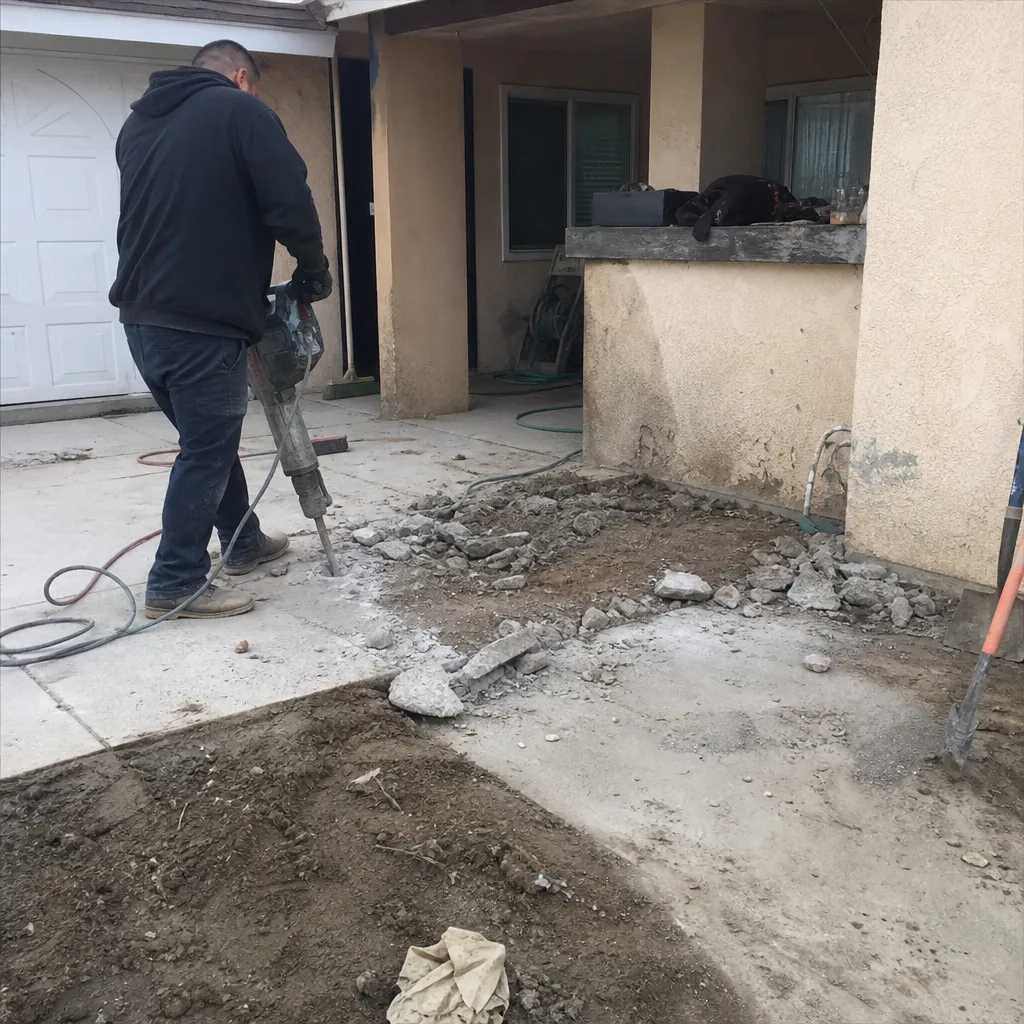
Concrete flatwork: Driveways, walkways, and patios in Rialto crack most often at re-entrant corners (inside corners where the concrete changes direction) and at the midpoint of long runs where control joints are spaced too far apart. Inspect every spring. Hairline cracks under 1/8 inch are cosmetic and can be sealed. Cracks over 1/4 inch that show vertical displacement (one side higher than the other) indicate soil movement, which requires a professional evaluation. In Rialto, the soil is a mix of sandy loam and clay. Areas with higher clay content expand and contract with moisture, which is why some neighborhoods see more slab movement than others.
Mortar joints on masonry: The mortar between bricks or blocks on retaining walls, planters, and the foundation skirting of older Rialto homes spalls over time due to thermal cycling. You’ll see powdery mortar at the base of walls and hairline separation where walls meet. Tuckpointing a retaining wall is a $1,500 to $3,000 job. Rebuilding a failed wall is $8,000 to $15,000. The annual inspection costs nothing.
Control joint sealant: The sealant in concrete control joints cracks and separates within three to five years in Rialto’s UV environment. When it fails, water gets under the slab and accelerates soil movement. Reseal control joints every two to three years with a polyurethane self-leveling sealant. The $30 kit does an average driveway.
We manage hardscape projects as part of whole-home renovations, and the same principle applies whether we’re installing a Belgard paver patio or replacing a cracked driveway: the base prep and joint spacing matter more than the surface material. A correctly installed concrete slab in Rialto should crack only at the control joints, not through the field. If your slab is cracking through the field, the base was undercompacted or the rebar was under-specified. That’s a $12,000 tear-out and replacement, not a maintenance item. Our Home Remodeling in Bloomington page covers how we approach hardscape as part of a complete exterior overhaul if you’re facing that level of work.
Exterior Paint and Siding: The UV Math
Rialto’s UV index averages 8 to 11 during summer, which puts it in the very high to extreme range. That translates to exterior paint failing in 5 to 7 years on south- and west-facing walls, versus 8 to 10 years on north- and east-facing walls. The difference is not subtle. If you stand in front of your home and notice that one side looks faded while the other looks fine, that’s the UV gradient doing its work.
What to check:
South and west walls: Look for chalky residue when you run your hand over the surface. That’s the paint binder breaking down under UV. Once chalking starts, the paint is protecting the substrate less with every passing month. Plan for repainting within 12 to 18 months.
Stucco hairline cracks: Rialto’s stucco homes develop hairline cracks from thermal cycling and minor soil movement. Cracks under 1/16 inch can be sealed with an elastomeric caulk before they widen. Cracks over 1/8 inch that go through the stucco layer need professional repair. Water behind stucco rots the underlying framing, and that’s a much bigger problem than the crack itself.
Siding systems: For wood-framed homes with lap siding, Rialto’s dry climate is actually forgiving. The rot issues that plague coastal homes are less common here because wood dries out between rain events. What we see instead is joint separation as the wood expands and contracts with thermal cycling. Check horizontal lap joints every two years. Re-nail any loose boards and recaulk joints that have opened up. For homes considering siding replacement, we install James Hardie fiber cement because it handles Rialto’s thermal cycling better than wood and carries a longer finish warranty.
Windows and doors: The same UV that fades paint also degrades the weatherstripping and seals around window and door frames. We referenced Therma-Tru doors earlier because their sill and frame construction holds up to Inland Empire sun better than builder-grade alternatives. The frames are not the weak point. The weatherstripping is, and it needs replacement every 3 to 5 years. A door that lets visible light through around the edges in the daytime is costing you money on every HVAC cycle.
For a deeper look at exterior maintenance, our Home Renovation in Bloomington guide covers how a full exterior envelope update, roof, siding, windows, doors, compares to piecemeal repairs. The math often favors the full update when you’re facing repainting plus window replacement plus roof work within a five-year window.
A Seasonal Maintenance Schedule for Rialto
If you want the shortest possible version of this guide, here it is as a four-season plan. Each season has one primary focus. Most Rialto homeowners skip one or two seasons and end up paying for it later.
Spring (March through May)
- Flush the water heater and check for scale buildup.
- Inspect concrete flatwork and masonry mortar joints.
- Check roof underlayment and gutters for winter damage.
- Replace HVAC filters and prepare the cooling system for summer.
- Service or replace weatherstripping on doors and windows.
Summer (June through August)
- Replace HVAC filters every 30 days during peak dust.
- Rinse condenser coils monthly to clear debris.
- Check hose bibs and shutoff valves for mineral buildup.
- Inspect south and west exterior paint for chalking and fading.
- Verify PRV pressure at a hose bib to catch creep early.
Fall (September through November)
- The Sept caulking walk: every window, door, and penetration.
- Inspect roof ridge caps, vents, and flashing before Santa Ana season.
- Tighten patio cover fasteners and fence post connections.
- Reseal concrete control joints before winter moisture arrives.
- Clear gutters and downspouts after the first leaf drop.
Winter (December through February)
- Check for water intrusion after each rain event.
- Exercise interior shutoff valves twice during the season.
- Inspect attic for wet insulation or staining after storms.
- Replace HVAC filters before the heating season’s dust load starts.
- Check roof for wind damage after Santa Ana events.
This schedule is not theoretical. It’s the sequence we follow when we take on a new Rialto renovation and assess what the previous maintenance routine missed, as detailed in our General Contractor Troubleshooting: Common Problems and How to Fix Them. The homes that look the roughest are rarely the ones with bad bones. They’re the ones where nobody did the September caulking walk for a decade, and the water followed the caulk.
Common Mistakes to Avoid
- Waiting until you see a leak to inspect caulking. By the time water shows up inside, the caulking failed months earlier and the damage is already in the wall cavity. The September inspection is the fix. The November leak is the consequence.
- Using interior caulk on exterior joints. Interior acrylic latex caulk breaks down in Rialto’s UV environment within a year. Exterior polyurethane or hybrid sealant lasts three to five years. The $3 savings is not worth the $800 water damage repair.
- Replacing HVAC filters on a 90-day schedule. Rialto’s dust load makes that schedule a slow-motion HVAC failure. Change the filter when it looks dirty, and in summer it will look dirty at 30 days.
- Ignoring water heater flushing because “it’s still working.” A water heater with a quarter-inch of scale still makes hot water. It just uses more gas and dies five years early. The flush is annual, not optional, in Rialto’s hard water conditions.
- Skipping the fence post check until the fence is leaning. By the time a fence panel leans, the post has rotted below grade and needs full replacement. The annual wiggle test catches it when you can still reinforce the post with concrete or replace a single post for $150 instead of a panel for $500.
- Assuming tile roofs don’t need maintenance. Tile protects the underlayment from sun, but the underlayment still ages. A tile roof that never gets inspected is the most common source of slow, destructive leaks in Rialto’s older homes.
- Painting over chalking exterior paint without addressing the substrate. Chalking is the old paint telling you it’s done. New paint over chalk fails early because there’s nothing for it to bond to. The surface needs proper prep, which means pressure washing and, in many cases, priming.
When to Call a Professional
Most of this checklist is DIY-appropriate. But there are specific Rialto scenarios where professional help saves money and prevents injury. If you see vertical slab displacement, cracked brick that runs through multiple courses, a roof leak that appears after every rain despite your best caulking efforts, or a water heater that rumbles even after flushing, those are structural or systemic issues, not maintenance items. A licensed general contractor can diagnose the root cause rather than treating the symptom. If you’re planning a larger update, whether that’s a full exterior refresh or a kitchen and bath renovation, it’s worth evaluating the home as a system rather than a list of individual repairs. For guidance on selecting the right professional, see our How to Hire a Construction Contractor in Rialto: A Step-by-Step Guide. Alder Contractors offers free estimates in Rialto. Call (833) 467-7020 and we’ll walk the property with you. You’ll get a written assessment of what’s urgent, what’s coming, and what can wait. No pressure, no upsell. Just a clear picture of the home you’re maintaining.
We’ve been the team behind renovations in and around Rialto long enough to know what these houses look like at year ten, year twenty, and year forty. The ones that get maintained on the schedule above look dramatically better at every milestone. The ones that don’t are the ones we’re called in to rescue. Start with the September caulking walk. It’s the cheapest hour of prevention you’ll spend this year. And if you’re considering a larger project, our Alder Contractors home page gives you the full picture of what we do, from roofline to backyard, under one contract and one point of accountability.
Frequently Asked Questions
A comprehensive home maintenance inspection in Rialto typically runs $200 to $500 depending on square footage and scope. For more guides & resources on protecting your home, visit our blog. Many contractors, including Alder Contractors, offer free estimates for specific renovation projects, but a standalone maintenance-only inspection is usually a paid service. The inspection pays for itself when it catches a $400 seam repair before it becomes a $6,000 membrane replacement. Call (833) 467-7020 to discuss what you need assessed.
In Rialto, south- and west-facing walls typically need repainting every 5 to 7 years due to extreme UV exposure. North- and east-facing walls can go 8 to 10 years. Stucco homes hold paint slightly longer than wood siding. If you run your hand over the surface and get chalky residue, the paint is already failing and should be scheduled within 12 to 18 months.
Yes. Rialto’s municipal water supply carries enough calcium and magnesium to build scale on water heater tank bottoms within three years. That scale reduces efficiency and causes premature tank failure. Annual tank flushing removes the buildup and extends water heater life from 8-10 years to 12-15 years. Ignore it and expect a new water heater sooner than you planned.
Inspect and tighten all exterior fasteners in October before wind season peaks: roof ridge caps, patio cover connections, fence posts, and vent covers. Check flashing and look for any component that moves when pressed by hand. Replace rusted fasteners rather than tightening them, and ensure any loose mortar on tile roof caps is re-bedded. Call (833) 467-7020 if you want a professional pre-wind assessment.
A full exterior caulking replacement on an average Rialto home runs $300 to $600 if done professionally, or under $50 in materials if done yourself. The water damage repair that follows failed caulking typically costs $1,800 to $4,500 for stucco repair, drywall replacement, and mold remediation. The economics strongly favor the $12 tube of sealant every September.
Yes, in three specific ways. Rialto’s dust load is higher than coastal Basin cities, which shortens HVAC filter life. The city’s hard water accelerates scale buildup more than nearby cities that rely less on groundwater. And while Rialto sits slightly outside the worst of the Cajon Pass wind corridor, Santa Ana events still cause enough fastener and flashing damage to require annual fall inspection. General guides that are written for Los Angeles or Orange County miss these local variables.
The Bottom Line
Rialto homes fail predictably, and that’s good news. The failure modes are known: UV-baked caulking, hard-water scale, wind-loosened fasteners, dust-clogged HVAC systems, thermally cracked concrete. None of these are surprises if you’re looking. The maintenance schedule in this guide costs the average homeowner under $500 per year in materials and occasional professional help. The alternative is a series of four- and five-figure repairs that arrive without warning. Start with the September caulking walk. Make it an annual ritual. Then work through the rest of the seasonal schedule. A house in Rialto that gets this level of attention will outlast its neighbors by a decade, and the savings compound every year you stay ahead of the damage. When the project is bigger than maintenance, when you’re ready to renovate rather than just preserve, call (833) 467-7020. We’ll walk the property and tell you exactly what we see.
Written by the team at Alder Contractors, serving Rialto since 2013.
See the difference
 Before
 After
 Before
 After
 Before
 After